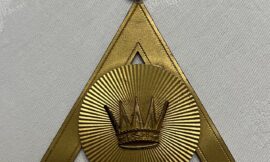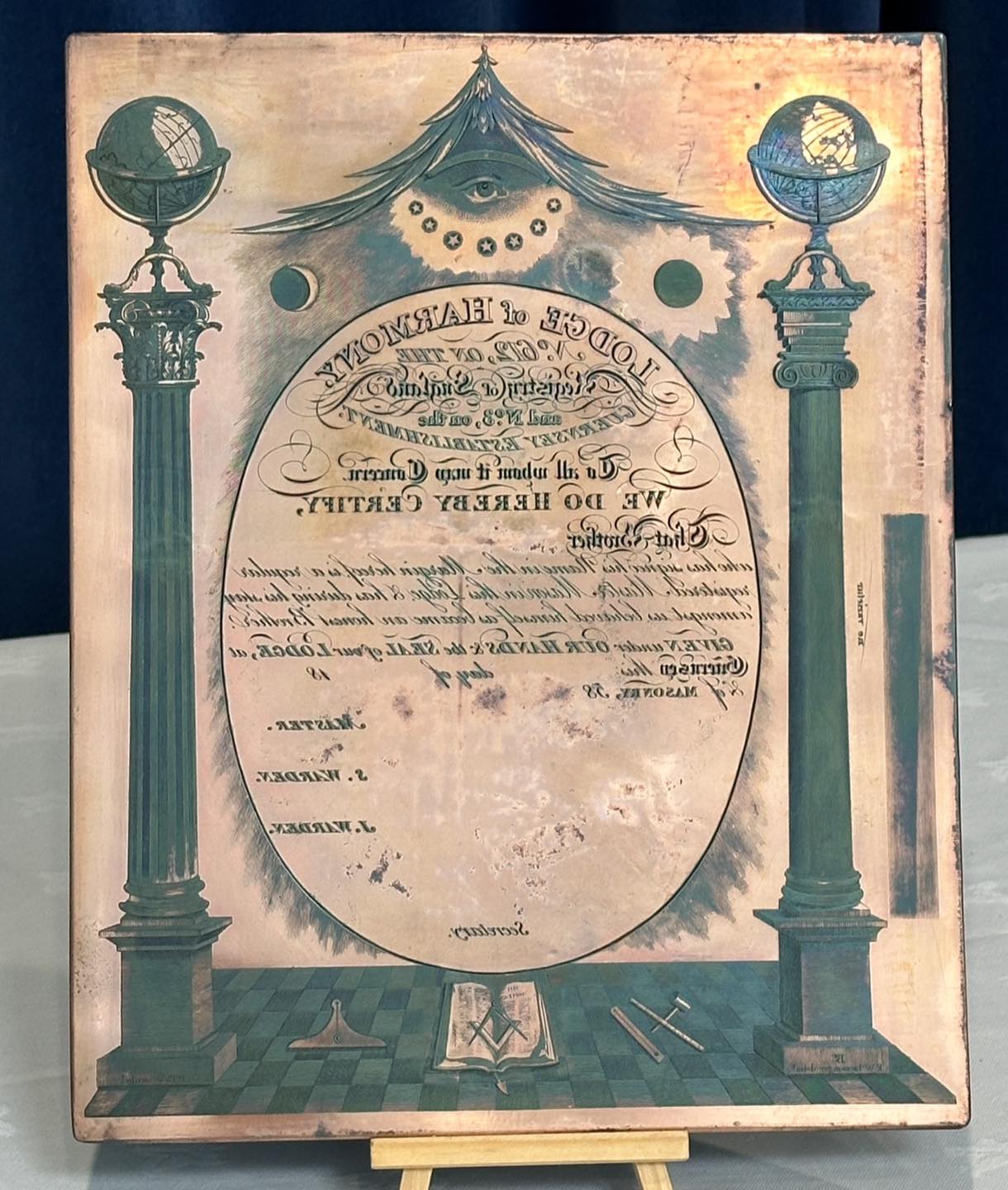
A copper printing plate related to Lodge of Harmony No.612, this Lodge is no longer in existence in the Province of Guernsey and Alderney but in the 250th Anniversary of the Lodge.
The Lodge of Harmony originally had the Number 472 and had been renumbered several times during its existence. The following is a list of all its numbers the years it was assigned the number and where it met.
No.472, 1774 – 1780 Meeting at Three Crowns Tavern, St. Peter Port,
No.378,1780 – 1781 Meeting at Three Crowns Tavern, St. Peter Port,
No.379, 1782 – 1812 Meeting at Three Crowns Tavern, St. Peter Port,
No.309, 1792 – 1812 Meeting at Three Crowns Tavern, St. Peter Port,
No.612, 1792 – 1814 Acting under an Athol Warrant
No.334,1805 – 1814 Meeting at King’s Arms and McDougalds Market Place, St Peter Port
No.619 1809 – 1829 acting under an Athol Warrant
No.428 1814 – 1829 Meeting at King’s Arms, St Peter Port
The Lodge was Erased on the 3rd of June 1829
Research carried out earlier this year means we have been able to locate that the Three Crowns Tavern, was located in the area of the Doghouse on the Rohais we must thank Mrs G Lenfestey for her assistance in this research.
This copper printing plate would have been used during the period 1792-1814 and was used to produce clearance certificates and has the wording “Lodge of Harmony No.612, on the Registry of England and No 3 on the Guernsey Establishment” in the upper part of the oval.
The main body of the text reads “To all whom it may concern, WE DO HEREBY CERTIFY That Brother(area for the brothers name to be written) Who has signed his name In the margin hereof is a regular registered Master Mason in this Lodge & has during his stay amongst us behaved himself as became an honest Brother, GIVEN under OUR HANDS & the SEAL of the LODGE at Guernsey” there are then areas left plan to have the date filled in and the signatures of the Master, Senior and Junior Warden of the Lodge added.
Clearance Certificate’s are issued to show that a Brother is in good standing with the Lodge and were also used to demonstrate membership of a Lodge when visiting.
The Printing Plate is decorated with various Masonic Symbolism including, The Volume of the Sacred Law, the Square and Compasses, Level and Plump Rule along with the Pillars and All-Seeing Eye.
For line engraving, copper was the preferred metal, with its earliest use recorded from the 1430s. Until the 19th century, when steel was introduced, few metals other than copper were employed for intaglio printmaking. Iron was used occasionally but it was very hard to engrave and most extant iron printing plates of the early 1500s suggest the material was better suited to etching. Lead and tin could also be engraved but they tended to be too soft for the printing of numerous fine illustrations, the plates wearing quickly after repeated inking and wiping. Sometimes brass was chosen; it was cheaper than copper, but it was much harder than pure copper and consequently more difficult to engrave. Bronze (copper mixed with tin and various other metals) could also be engraved and was, in fact, used for plates in France throughout the 19th century. Merely an alloy of copper, though, it too proved inferior to the naturally occurring element. Copper could be etched, it was soft enough to be exquisitely engraved, it could be scraped, polished, and printed from a thousand times over; it was readily available and much less expensive than silver and gold. It wasn’t cheap, though, and for this reason copper plates were occasionally engraved on both sides, this plate is only engraved on one side. Printing from copper plates is the technique of transferring to a sheet of paper, a piece of satin or any similar material the imprint of lines etched with acid or engraved, with a burin or by some other means, on a plate of copper or of wood.
The operation is carried out by means of two rollers between which the inked plate is made to pass. These rollers form part of a machine called a press. The action of the rollers transfers the ink from the engraved lines on the plate to the paper, vellum or satin which is placed over it.